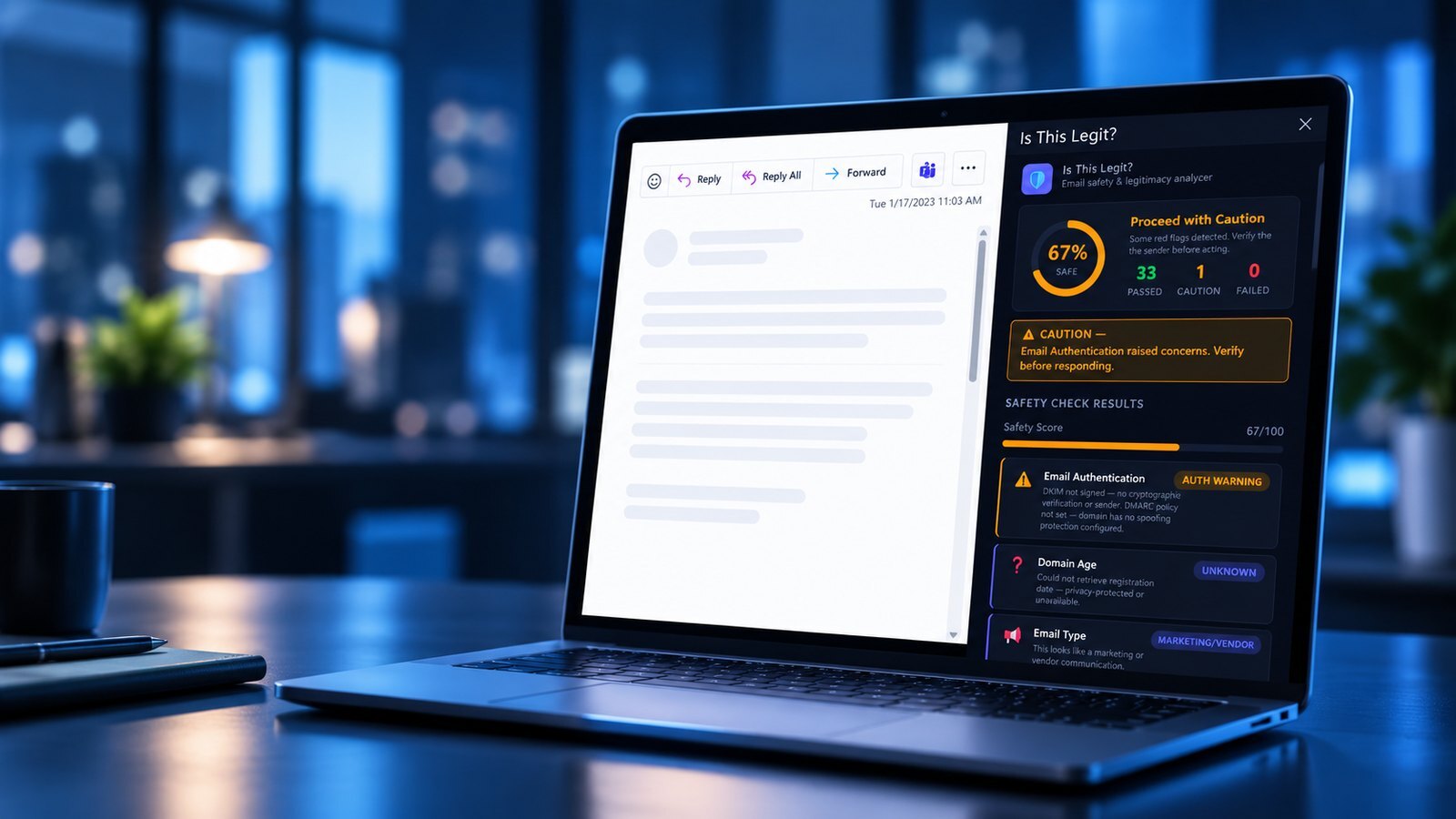
Before you trust the email, check it.

IsThisLegit gives employees a simple way to verify suspicious messages directly inside Outlook before they click, reply, share information or act on a request.


isthislegit-hero-web
34
34 safety checks Signals are analyzed automatically when an email opens.

1–3s
Fast analysis A clear verdict appears in seconds.
0
No local installs Deployed centrally through Microsoft 365.
0
No data collected Email content is not sent to a third party for review.
01 / THE PROBLEM

The message can look legitimate and still be dangerous.

Modern phishing often arrives with professional writing, familiar names, and legitimate-looking infrastructure. Spam filtering may let it through, leaving an employee to make a judgment call with little guidance.

The old warning signs are disappearing. AI has made it easier to create polished, personalized messages that feel like ordinary business.
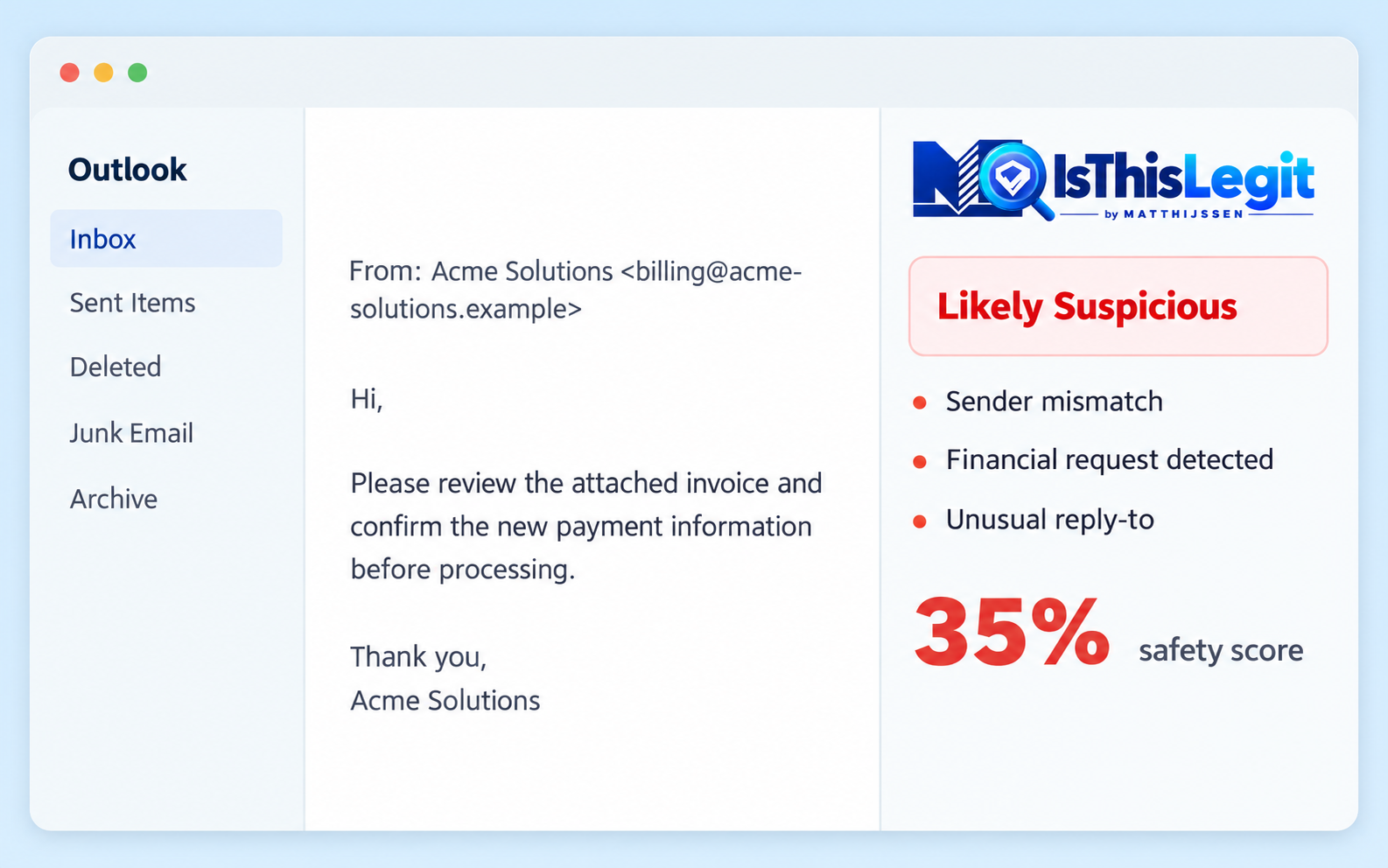
Phishing Analysis Email Dashboard
A REAL-WORLD EXAMPLE

A familiar request arrives.

No malware required
Looks like a known sender
No password prompt
Asks the employee to act
The safest next step is verification before action.
02 / HOW IT WORKS

A simple process for safer email decisions.

IsThisLegit runs in the background when an email is opened, then turns dozens of technical signals into a verdict that ordinary users can understand.

01

OPEN

 Open any email in Outlook. The add-in loads automatically. 

02

CHECK

Sender, domain, authentication, language, links and attachment indicators are analyzed.

03

REVIEW

A 0–100 safety score, color-coded verdict and plain-English explanation appear.

04

DECIDE

Three clear action steps tell the employee what to do next.

34
different safety signals
1–3s
typical analysis time
0
local software installs
0
email content sent for external review

03/ SEE IT IN ACTION

See how IsThisLegit works inside Outlook.

Watch how an employee can check a suspicious message and get a clear, plain-language result in seconds.

04 / WHAT IT CHECKS

A clearer picture of email risk.

The analysis combines identity, authentication, behavior, links and attachments instead of relying on one signal alone.

Sender & domain verification

  • - Domain age and registration
  • - Lookalike and spoofed domains
  • - Display-name mismatches
  • - Suspicious reply-to addresses

Authentication & impersonation

  • - SPF, DKIM and DMARC validation
  • - "On behalf of" sender checks
  • - Executive impersonation
  • - Brand impersonation

BEC patterns

  • - Invoice fraud language
  • - Payroll diversion requests
  • - Hijacked or fabricated threads
  • - Urgency and social-engineering cues

Links & attachments

  • - Shortened and redirected links
  • - Cloud-document verification
  • - Links hidden inside PDF attachments
  • - Attachment and file-type indicators

Plain-language scoring

  • Turn continuous change into a manageable security process.
  • - Color-coded verdict
  • - Red flags listed first
  • - Reason for concern in plain English

Next action

  • - Were you expecting this email?
  • - Call known contacts to confirm
  • - Delete/report unfamiliar messages
  • - Escalate when needed
90–100%
Looks Legitimate
Passes all checks. No action needed.
75–89%
Mostly Safe
Minor concern. Use your judgment.
55–74%
Proceed with Caution
35–54%
Suspicious Email
Verify the sender by phone before acting.
0–34%
Likely Phishing
Do not engage. Report as phishing.
05 / REAL-WORLD PROOF

Built around attack patterns seen in production.

 The case study documents payroll diversion, business email compromise, a mass phishing campaign that slipped past spam filtering, and a legitimate CFO message that helped improve false-positive handling. 

Payroll diversion attempt

A lookalike colleague request to update direct deposit was flagged, prompting a call to HR. Fraud was prevented.

Company impersonation / BEC

An urgent request from an unrelated domain scored 5% and was classified as likely phishing.

Mass phishing campaign

A polished PDF message passed the spam filter but was flagged for a foreign domain, random username and impersonal greeting.

Legitimate CFO email

A false positive exposed a parsing weakness. The analysis was improved and the legitimate message then scored 100%.

06 / PRIVACY & SECURITY

Designed to be useful without becoming invasive.

What it accesses

Sender name and address, subject line, reply-to, CC list, email headers and attachment names for the message being analyzed.

What it does not send externally

Email body content, attachment contents, other mailbox messages, contacts and calendar data are not sent out for review. The only external lookup described in the case study is the sender domain against a public registration database.

Central deployment

The add-in is deployed through the Microsoft 365 Admin Center and requires no local software installation on employee devices.

Works where people work

IsThisLegit runs directly inside Outlook across desktop, web and mobile, with nothing separate for employees to configure or manage.

07 / FAQ

Common questions about IsThisLegit.

Does IsThisLegit replace spam filtering?

No. It is an extra layer at the point of decision. The case study includes a phishing message that passed the spam filter but was still caught by IsThisLegit.

Does it work inside Outlook?

Yes. IsThisLegit runs directly inside Outlook so employees can review a message without switching to a separate application.

How fast is the analysis?

Typical analysis takes about 1–3 seconds, giving the user a safety score, verdict and plain-language explanation while the message is open.

Does it guarantee an email is safe?

No. IsThisLegit is a supplementary security layer designed to help employees make better decisions. No security tool can guarantee that every message is safe or malicious.

ISTHISLEGIT OUTCOME

Give employees a clearer answer before a suspicious email becomes an incident.

Make verification part of the workflow.

IsThisLegit adds a practical second opinion between a suspicious message and the action that could turn it into an incident.
Talk to Matthijssen about IsThisLegit