MATTHIJSSEN AI BILLING SOLUTIONS
CLIENT CASE STUDY | INTELLIGENT AUTOMATION
Intelligent automation gives billing teams their time back
How a Professional Services Automation (PSA) system built by Matthijssen reduced a recurring 60-hour monthly billing process to about 8 hours, while keeping people in control of review and accuracy.
|
60 → 8 staff hours per month |
100+ invoices handled monthly |
2 → 1 people needed for the process |
|
The result About 52 staff hours returned every month, with human review and accuracy controls still built into the process. |
At a glance
|
Challenge |
Repeated manual entry across disconnected billing and accounting systems. |
|
Approach |
Read invoice PDFs, apply business rules, surface exceptions, preserve human review. |
|
Outcome |
Monthly effort fell from about 60 staff hours across two people to about 8 hours for one. |
1 | THE BETTER QUESTION
Why spend 60 hours every month rebuilding information the business already has?
The work required over 100 invoices. Manually entered twice. Every month.
Many business processes depend on information moving from one system to another. When those systems do not connect, employees become the connection: re-entering data, applying business rules, checking results and carrying information forward.
In this recurring VoIP billing process, the source system could not make the recurring adjustments the business needed and offered no API or export with the required information. Staff keyed each invoice into a spreadsheet, relied on Excel formulas for adjustments, then entered the invoice data again into accounting and the adjustments back into the source system.
|
100+ invoices every month |
2 employees sharing the work |
60 combined staff hours / month |
Where the process broke down
|
No recurring adjustments |
The source system could not make the recurring billing changes the business required. |
|
No usable API/export |
There was no direct integration path containing the information needed. |
|
Limited history |
Customer and invoice context was difficult to retain and share. |
|
Double entry |
Invoice data was keyed into a spreadsheet and then entered again into accounting. |
|
Fragmented visibility |
Services, billing and profitability were not visible together. |
Before the PSA
|
1 Read Each PDF invoice |
2 Key in Invoice data to spreadsheet |
3 Calculate Excel formulas |
4 Re-enter Invoice data to accounting |
5 Adjust Changes in source system |
2 | THE BETTER ANSWER
Intelligent automation handles the repetition. People keep the judgment.
The PSA carries information through the process, applies established rules and surfaces exceptions, while review and accuracy remain in human hands.
How the automated workflow works
Because the source system had no API or export with the required data, the PSA starts with the PDF invoice itself. It reads the invoice, identifies the customer and charges, and cross-references the customer type to calculate recurring adjustments.
Rules and error notifications surface missing setup before it becomes a billing problem. The user reviews the calculated adjustments, enters what must still be entered in the source system, confirms totals match, and then posts verified invoice detail into accounting.
|
1 Read Invoice detail AUTOMATED |
2 Calculate Customer type + rules AUTOMATED |
3 Review Human verification HUMAN |
4 Enter Adjustments to source system HUMAN |
5 Post Verified detail to accounting AUTOMATED |
Three operational improvements beyond time savings
|
One source of truth Customer records, types, charges and a full invoice archive live in one place. |
Context stays with the customer Shared notes keep billing increases, decreases and other account context available to the team. |
Original and corrected are retained The source invoice remains available for double-checking, while corrected versions can be downloaded and sent when needed. |
|
|
Built on confidence During rollout, the team checked automated output against the existing process for one to two months before fully switching over. |
|
||
THE HUMAN CONTROL POINT
Human review is not a workaround in this design. It is the control point.
Automation does the repetitive handling. People review, decide, resolve exceptions and remain responsible for accuracy.
What automation does
- Reads invoice detail from PDFs
- Identifies customers and charges
- Applies established customer-type and billing rules
- Surfaces missing setup and exceptions
- Carries verified invoice detail into accounting
- Review calculated adjustments
- Resolve exceptions and missing setup
- Enter adjustments that must remain in the source system
- Confirm totals match
- Remain responsible for final accuracy
What people still do
|
Design principle The goal is not to remove people from the process. It is to remove the repetitive work around them. |
Why that balance matters
|
Efficiency |
The machine handles repeatable reading, rules and record movement. |
|
Control |
People keep approval, judgment and exception handling. |
|
Traceability |
Original invoices, corrected invoices and shared history remain available. |
|
Scalability |
A repeatable workflow can absorb volume without recreating the manual process. |
3 | THE BETTER OUTCOME
Over 600 documented staff hours a year returned to work that matters.
The recurring process still includes human review. What changed is how much repetitive handling surrounds that work.
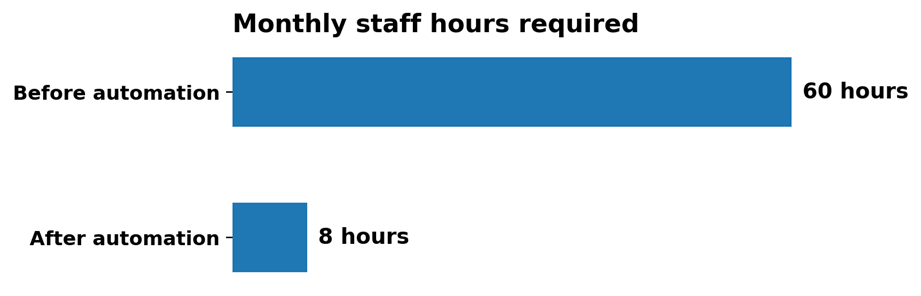
About 87% less staff time required each month.
|
~52 hours returned / month |
~624 hours returned / year* |
100+ invoices handled / month |
2 → 1 people needed |
Once the team trusted the output, the monthly workload fell from roughly 60 staff hours across two people to roughly 8 hours for one. Review still happens and judgment still belongs to people. Much of the repetitive entry, calculation and record handling around those decisions is what disappeared.
The PSA also keeps shared invoice history, making it easier to verify what happened, retrieve an original or corrected invoice, and answer questions without rebuilding the record from spreadsheets, paperwork or individual memory.
What did not change
|
The rigor Each adjustment is still verified to match before an invoice goes to accounting, and the original invoice is retained for double-checking. Accuracy remains a human responsibility, with far less repetitive effort behind it. |
*Approximate annual figure based on a recurring reduction from about 60 staff hours per month to about 8.
THE MATTHIJSSEN DIFFERENCE
Automation built around the business process, not the other way around.
This case study started with a practical question: why should employees spend dozens of hours every month rebuilding information the business already has? The answer was not to replace judgment. It was to redesign the repetitive work around it.
The pattern Matthijssen looks for
|
Disconnected systems |
Employees manually bridge tools that do not integrate. |
|
|
Repeated entry |
The same information is entered more than once. |
|
|
Rules that can be defined |
Business logic can be consistently applied by software. |
|
|
Exceptions that need people |
Judgment stays with the people who understand the business. |
|
|
A measurable outcome |
Time, accuracy, consistency and visibility can all be tracked. |
|
|
What could your team do with more time? Bring your next billing or productivity challenge to Matthijssen. We design practical automation around real business processes, existing systems and the people who use them. |
|
|
AI Billing Solutions | www.mattnj.com/ai-billing-solutions
Matthijssen Inc. | People. Productivity. Possibility.